

A homeowner can be clear about who should receive a home and still have unanswered questions about how that transfer will happen. The intention and the arrangement are different parts of the work.
Maryland’s Transfer-on-Death Deed Act adds an option to that conversation. Chapter 751 took effect on October 1, 2026, creating a framework for an owner to name a beneficiary who can receive the property at death without that transfer going through probate. The change is now law, rather than a proposal awaiting implementation. Maryland General Assembly, Chapter 751.
The appeal is understandable: arrange the future transfer while retaining control of the home today. But a home is also somewhere people live, an asset with expenses and sometimes debt, and a property that may eventually need to be sold. Naming its next owner addresses one part of that larger picture.
Our view is that the new tool makes the quality of the planning conversation more important. The useful distinction remains the owner’s goal, the legal fit of an arrangement and the work required to put it into effect. Understanding those separately can reveal whether a seemingly simple answer actually addresses the question the household needs answered.
What transferring outside probate accomplishes
A transfer-on-death deed, often shortened to TOD deed or TODD, is a revocable, nontestamentary instrument. In practical terms, it creates a route for the described property to pass at death under the deed. Maryland’s statutory information sheet expressly says probate is unnecessary for that transfer. The deed must meet the applicable requirements, including acknowledgment and recording before the owner’s death in the jurisdiction where the property is located. A signed document left among personal papers does not complete that work. Real Property § 14-1011.
That is a meaningful addition to the available choices. An owner can consider a mechanism directed specifically at the property’s future transfer. The benefit deserves to be understood on its own terms, without assuming every planning task must become more elaborate.
The boundary is the property covered by the deed. A TOD deed does not establish how all the owner’s other assets will pass or resolve the administration of an entire estate. Maryland Courts describes probate administration as work that can include identifying probate assets, addressing valid estate claims and taxes, and distributing what remains. Other assets may still require that process. Maryland Courts, estate administration.
For Housecats, this is the first useful correction to the shorthand. Avoiding probate for a property can be a legitimate objective. It should remain distinct from the broader goal of leaving the people involved with a workable arrangement. The law establishes a transfer mechanism; it does not establish a universal saving in time, expense or effort for every owner.
The owner keeps control during life
During the owner’s lifetime, the deed creates no legal or equitable interest for the designated beneficiary. It preserves the owner’s rights, including the ability to transfer or encumber the property. It also leaves other owners’ rights intact. These are explicit features of § 14-1007, not benefits that depend on a beneficiary informally agreeing to stay out of the way. Chapter 751, page 16.
This matters to an owner whose future needs may change. A designation for a transfer at death does not itself turn the beneficiary into a current co-owner. The distinction is worth discussing before treating a TOD deed and adding someone to the present title as interchangeable decisions.
Retained control also creates an ongoing responsibility to keep the arrangement aligned with the owner’s intentions. Maryland provides methods for revoking a recorded TOD deed through an executed, acknowledged instrument recorded before death. A later will does not revoke it, and destroying the owner’s copy does not undo the recorded deed. Joint-owner revocation has additional rules. Real Property § 14-1008.
The planning implication is straightforward: a change of mind needs to reach the relevant legal documents. An updated will and a different family understanding are not reasons to assume the land records now reflect a new intention. Before a later sale or another ownership change, the existing deed should be part of the professional review. That keeps the future-transfer decision connected to what the owner is doing with the property today.
The Act does not require notice to, delivery to or acceptance by a designated beneficiary during the owner’s life. Chapter 751, § 14-1006. That legal rule leaves a practical communication choice. Subject to the owner’s wishes and circumstances, a conversation can establish whether the intended recipient understands the arrangement and knows where to find its documentation. A designation that can operate without advance acceptance still deserves thought about how the people affected will learn of it.
A future beneficiary is a different role from an agent
A designation that takes effect at death also leaves a separate lifetime question: who can act if the owner becomes unable to manage financial affairs?
Naming someone as a TOD beneficiary does not itself appoint that person to manage the owner’s property during incapacity. The deed’s lack of a present beneficiary interest is central to the distinction. Maryland Courts describes a power of attorney as a separate tool through which a person can authorize an agent to make financial or business decisions on their behalf. Maryland Courts, life planning.
For a household, the practical discussion might concern who could deal with property bills, an urgent repair or a necessary transaction if the owner could not act. Those are questions about authority during life. Identifying the intended recipient after death does not answer them.
The TOD statute also makes the capacity required to create or revoke the deed the same as the capacity required to make a will. That is a legal standard for counsel to assess, not something a relative or real-estate adviser should infer from a person’s willingness to sign. Chapter 751, § 14-1004.
Our interpretation is that continuity deserves its own place in the plan. Ownership after death, decision-making during incapacity and everyday help with a home may involve different people and different authority. A useful conversation makes those roles explicit without assuming one document can supply all of them.
The existing ownership and the beneficiary choices matter
The starting document is the current deed. A person’s understanding of the household arrangement may not describe the actual ownership interest or survivorship rights.
Under the TOD Act, when an owner holds property with survivorship rights and another such joint owner survives, the property belongs to the surviving joint owner or owners. The TOD mechanism becomes effective for the last surviving joint owner at that owner’s death. The law also addresses a beneficiary’s survival, alternate beneficiaries and lapse. These provisions make the sequence of ownership and death consequential. Chapter 751, § 14-1009.
An owner therefore needs more than a list of names. What interest can this owner transfer? What happens if a beneficiary dies first? How do the deed and the applicable rules interact with other owners’ rights? Those questions belong in the legal assessment before the household treats its intended result as settled.
Multiple beneficiaries introduce another distinction. Section 14-1003 allows the deed to specify a form of ownership; if it does not, Maryland’s default is joint tenancy with rights of survivorship. The statutory information sheet specifically directs owners to consider whether that structure suits their beneficiaries. A desire to benefit several people does not, by itself, resolve how their ownership should work. Real Property § 14-1011, common questions.
The transfer is also subject to statutory limitations, including a surviving spouse’s elective share and provisions concerning certain children omitted from an estate plan. The Act incorporates rules concerning later family events, including divorce. The effect of a particular event or claim requires individual legal analysis. Chapter 751, page 18.
From a property-planning perspective, naming beneficiaries is only the beginning of understanding their future relationship to the home. Their ability to make decisions together, their preferences about keeping or selling, and the needs of anyone living there deserve discussion. Those practical questions do not determine the legal answer, but they help reveal what the legal arrangement needs to address.
The property can transfer with obligations attached
The new deed does not erase the property’s existing burdens. Section 14-1009(B) provides that the beneficiary takes subject to the conveyances, encumbrances, contracts, mortgages, liens and other specified security agreements affecting the property at the owner’s death. The same section says the transfer carries no covenant or warranty of title. Chapter 751, page 19.
That distinction matters to the person receiving the home. Becoming its owner and receiving an unencumbered asset are different outcomes. A plan centered on who receives the property should also make room for understanding the obligations attached to it.
Creditor questions require similar care. During the owner’s life, the statute preserves secured and unsecured creditors’ rights; the TOD designation does not move the property beyond the owner’s creditors. Chapter 751, § 14-1007. After death, an existing lien on the property, a claim against an estate and a beneficiary’s personal liability are distinct legal questions. The encumbrance provision alone should not be read as a finding that the beneficiary personally owes every debt the owner left behind. Nor does the nonprobate label establish that every possible claim disappears.
For a household assessing whether keeping the property is realistic, our concern is the practical picture: what obligations need review, what expenses may continue and what resources would be available? Property taxes, insurance, maintenance and financing belong in that conversation as applicable. This is a planning interpretation, not a calculation of anyone’s liability or carrying costs.
A transfer can express the owner’s intention clearly while leaving the recipient with decisions about affordability and use. Recognizing those decisions early gives the intention more substance.

Probate treatment and tax treatment are separate
Maryland’s statutory TOD information sheet warns that the deed does not avoid inheritance taxes. The Register of Wills explains that inheritance tax can apply to both probate and nonprobate property, with exemptions depending on the recipient and applicable law. Passing through a deed does not, by itself, answer the tax question. Maryland Register of Wills, inheritance tax.
There is a separate, narrower tax provision in the new Act. A qualifying TOD deed for the transferor’s primary or secondary residence is exempt from recordation tax, with related state and county transfer-tax exemptions. That concerns specified taxes associated with the instrument. It should not be translated into a general statement that inheriting or later selling the home is tax-free. Chapter 751, Tax–Property provisions.
Estate tax is another distinct subject. The Maryland Comptroller explains that the gross estate for estate-tax purposes includes both probate and nonprobate property. Whether an estate has a filing or payment obligation requires the applicable rules and the estate’s circumstances. Maryland Comptroller, estate and inheritance taxes.
For the owner and intended beneficiary, the useful next conversation separates the costs of recording, potential taxes at death and the tax consequences of a later sale. A tax professional can evaluate those subjects together with the actual ownership and estate plan. This article does not calculate a tax bill, promise a particular tax basis or recommend a transfer method for tax savings.
The broader point is precision. A favorable rule in one part of a transaction is not evidence that every other financial question has been resolved.
A transfer at death does not establish a sale timetable
Maryland provides an optional notification-of-death form. Section 14-1013 says recording that notice is not required to effect the transfer, which is deemed to occur at death. It also directs the clerk to forward the notification to the State Department of Assessments and Taxation. The legal transfer and the work of documenting it in public records are related, but distinct. Chapter 751, § 14-1013.
That distinction matters if a beneficiary expects to sell. The effective date of ownership is one question. What documentation the professionals handling a particular sale need, what title issues require attention and when the property can actually close are further questions. Those should be established for the property rather than inferred from the phrase “automatic transfer.”
Our real-estate interpretation is to work backward from the intended use. Keeping the home calls for a discussion of responsibility and resources. Selling calls for a discussion of authority, title review, property preparation and timing. Neither course is made suitable merely by the deed’s existence.
The people living in the home also belong in that discussion. The future owner and the current resident need not be the same person. If continued occupancy is part of the goal, counsel should assess what rights and arrangements support it. A beneficiary designation should not become a substitute for examining those rights, and this article draws no conclusion about anyone’s entitlement to remain or a new owner’s ability to require a move.
These are possible household consequences, not claims about Maryland sale times or market supply. The sources reviewed do not establish that TOD properties sell sooner, produce better proceeds or create a measurable increase in listings.
A recording office has a different job from an adviser
Maryland Courts draws a clear service boundary. Land-records clerks accept qualifying documents and maintain the records. They cannot fill out documents, tell an owner whether a document accomplishes the owner’s goals, perform a title search or provide legal advice. Maryland Courts, land records.
For local context, the Carroll County Circuit Court Clerk’s office announces that its Land Records department began recording TOD deeds on October 1, 2026, and links the Maryland Volunteer Lawyers Service guide. That is useful confirmation from one office. It does not establish every Maryland jurisdiction’s process or turnaround time. Carroll County Clerk’s notice.
The September 2026 MVLS guide expressly cautions that local processing practices may differ and directs readers to confirm procedure and charges. Its planning warnings include mismatches in ownership information, multiple beneficiaries, owners with differing goals and pressure to sign. It also acknowledges that some owners cannot readily access a lawyer and provides legal-services resources. MVLS user guide, pages 3, 6, 9–10 and 30–32.
That access point matters. A useful public tool should be understandable to the people it is intended to serve. Recognizing its limits should help owners identify the questions that need assistance, rather than leave them with the impression that planning is beyond their reach.
The office can clarify its current recording process. Counsel can assess legal fit. A tax professional can address the relevant tax questions. A real-estate adviser can help frame property-use and sale considerations. Giving each question a clear destination makes the conversation more productive.
Start with the goal for the home
The most useful preparation is a clear statement of the intended outcome. Keeping a property available for someone’s use, dividing its economic value and arranging an eventual sale are different goals. They may call for different discussions even when the same beneficiaries are involved.
It is also useful to distinguish attachment to the home from the resources needed to retain it. A recipient might value the property while having a different intended use for it. As a planning judgment, making room for that conversation can expose competing preferences before they become decisions that must be made after a death.
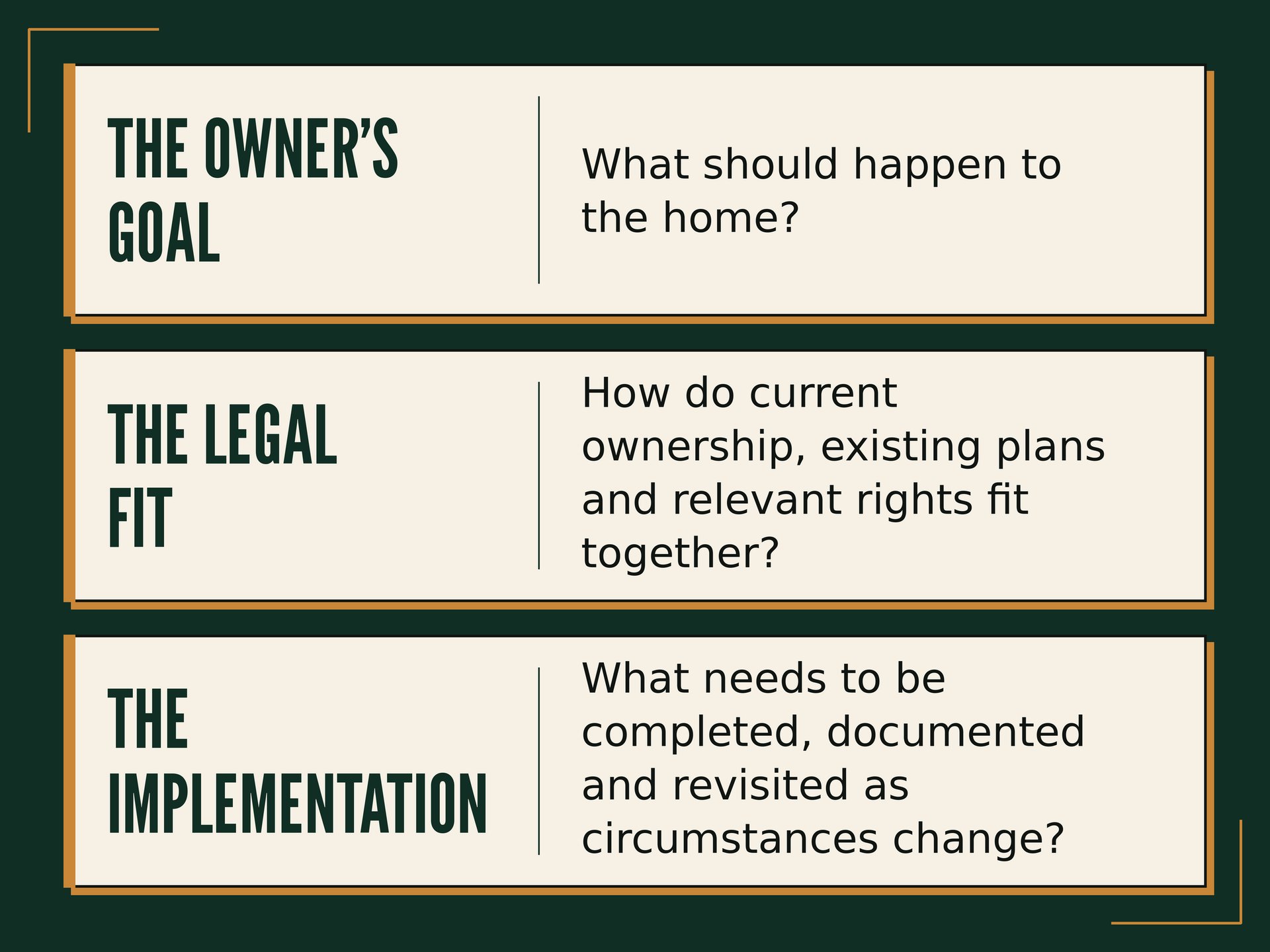
Our framework is to separate three matters:
- The intended outcome. What should happen to the home, who might live there and which preferences are essential? Identify assumptions about expenses, future use and cooperation before treating them as agreement.
- The legal fit. How do the current title, existing planning documents, beneficiary choices and relevant rights work together? Ask qualified counsel which questions the proposed deed answers and which need another arrangement.
- The implementation. What must be completed, where will the recorded documents be kept, and who will know where to find them? Confirm current local procedure and identify changes that should prompt another review.
This is a framework for a more specific conversation, not a selection of a deed, trust or other method for the reader. A simple arrangement can be appropriate when it fits a clear goal. Greater complexity is justified only when it addresses something the simpler approach leaves unresolved.
What to watch as the new law is used
The next useful evidence will concern implementation and outcomes. Updated instructions from a recording office can clarify local practice. Published legal analysis or court decisions may clarify disputed applications. Documented experience with completed transfers could show where owners encounter problems and what helps resolve them.
Those findings should identify the jurisdiction, period and question examined. A count of recorded deeds would show use; it would not establish that each owner’s intentions were fulfilled. Claims about savings, speed or fewer disputes need evidence of those outcomes.
For now, the new law offers another way to connect an owner’s intention to a future transfer. The work is to understand that connection well enough that the people involved know what has been arranged and what still needs attention.
Continue with more Housecats Signals for perspectives on property ownership and the decisions around a home.
This article provides general information and editorial interpretation, not individual legal, tax, financial or estate-planning advice. Sources were checked on November 2, 2026. A qualified professional should assess an owner’s circumstances; the relevant recording office should confirm current local procedure.