
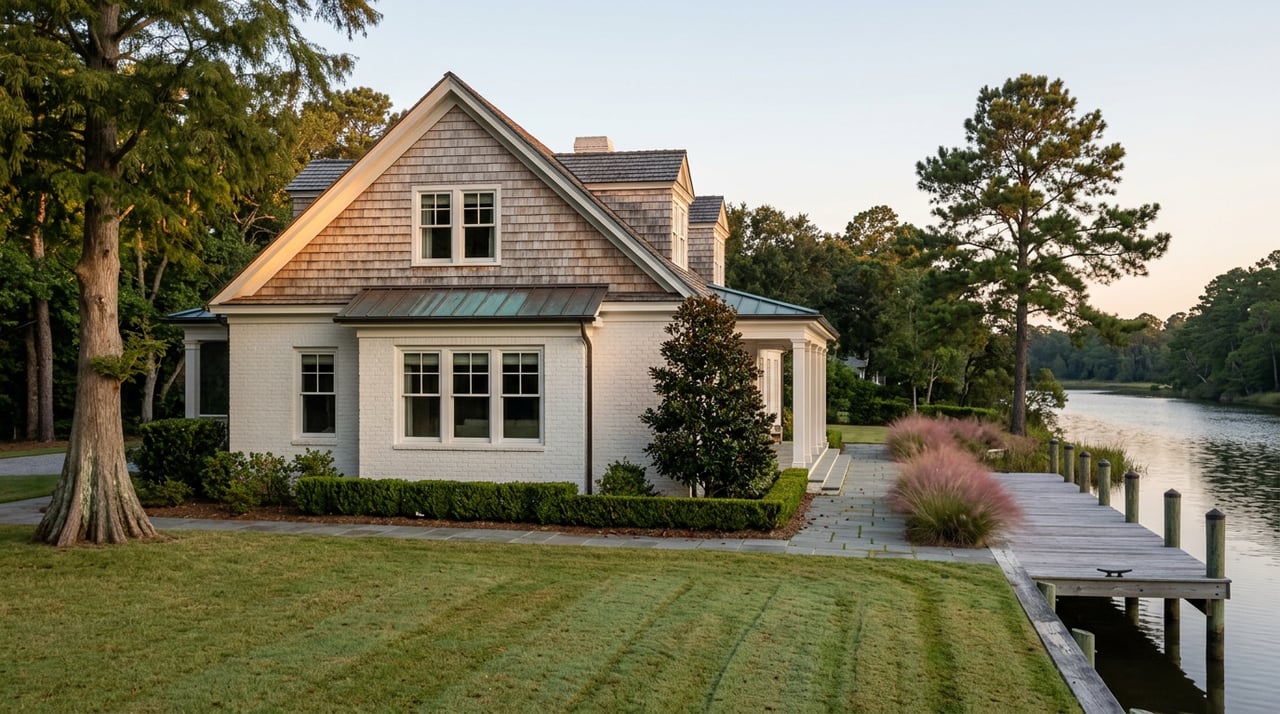
In 2021, the Downs Property Owners Association filed a public notice with state waterways regulators asking permission to tear out an aging marina and build something better. The filing reads like an engineering spec, not a listing description: a 61-foot fixed pier with a 33-foot gangway, a main floating pier plus five auxiliary floating piers running roughly 1,471 linear feet, 26 floating finger piers, 23 boat lifts, 69 mooring piles, and structures extending as far as 390 feet from the mean high water line. Tucked into the same application was a request to replace 408 linear feet of deteriorated bulkhead, set no more than 18 inches channelward of the original line.
That is not marketing copy. That is a permit application, and it tells you something a listing sheet never will: the marina in this neighborhood is infrastructure the whole community owns together, and it was, by the letter of its own filing, falling apart.
By late 2024, listing descriptions for homes in the community had started referencing a newly finished Clements Creek Marina with floating docks. Read the two documents side by side and you get a real timeline: a capital project proposed in 2021, built out over the following years, and complete enough by 2024 that agents were using it as a selling point. That gap between filing and finish is worth sitting with, because it explains something buyers often miss about waterfront communities on the Severn. The house is not the whole asset. The shared infrastructure attached to it matters just as much, and that infrastructure has a maintenance cycle, a capacity limit, and now a documented rebuild.
Membership, Not a Private Dock
Every one of the roughly 225 properties in Downs on the Severn belongs to the Downs Property Owners Association, and that membership is what actually grants access to the water, not individual lot lines. The community runs two marinas, and they are not interchangeable.
| Marina | Capacity | Vessel size | What's included |
|---|---|---|---|
| Clements Creek Marina | 76 slips | Mostly 30 to 50 feet, a limited number at 20 feet | Electric service on 30-foot-and-larger slips, freshwater, pump-out, picnic area, restrooms, dinghy racks |
| Brewer Creek Marina | Small-craft facility | Generally under 23 feet | Launch and land access for small boats, jet skis, and personal watercraft, with trailer storage for actively used craft |
Seventy-six slips serving roughly 225 to 250 households is not a one-to-one guarantee of dockage. It is a shared resource administered by an all-volunteer marina committee, which is also the reason fees have stayed reasonable relative to what you'd pay at a commercial marina nearby. But shared and reasonably priced also means allocated. The community's own site maintains a running page for vacant slips at Clements Creek and a separate process for applying for one, which tells you plainly that a slip is not bundled into a property deed. It is leased, administered, and occasionally waited on.
Compare that to Epping Forest, a few minutes south along the same river, where the marina is privately run through the community's boat club rather than an HOA committee, and demand for its limited slips has been enough to produce a waiting list. Neither model is better or worse. They are simply different answers to the same question: who controls access to the water, and how much of it is there to go around. A buyer moving from a neighborhood with private, lot-attached docks needs to understand that in Downs on the Severn, the answer runs through a committee and a vacancy list, not a title search.
What the Price Spread Is Actually Measuring
Homes in this community have ranged this year from listings starting in the mid-$800,000s to active luxury listings north of $4.9 million, and local waterfront specialists have tracked at least one record-setting sale that closed at $6.7 million. Square footage alone does not explain that range. Homes here run from roughly 2,400 to just over 7,000 square feet, which is real variation but nowhere near enough to account for a price gap that size.
What does account for it is a combination of water depth, bulkhead condition, creek frontage versus river frontage, and proximity to the rebuilt marina. A home on a deep-water lot with its own frontage on Clements Creek, backed by a bulkhead that doesn't need the kind of replacement the HOA just financed community-wide, is a fundamentally different asset than a home two streets back that relies entirely on a leased slip at the shared marina. Both are technically water-privileged. They are not equivalent purchases, and the list price usually reflects that even when the marketing language doesn't spell it out.
It helps to hold this against the broader Annapolis market for scale. As of mid-2026, the citywide median sat near $609,000, with well-presented homes typically going under contract within about 30 days. Downs on the Severn's price floor already sits well above that citywide figure before you even factor in marina access, which is a reminder that this neighborhood was never competing on affordability. It competes on what the water actually delivers, and that is exactly why the internal spread deserves more scrutiny than the neighborhood's average would suggest.
Anne Arundel County has a genuinely finite amount of tidal shoreline. New marina capacity does not get built easily or often, which is part of why a rebuilt, HOA-run facility with 76 slips is a meaningful asset rather than a footnote. It is also why a buyer comparing two similarly priced homes in the same neighborhood should ask which one comes closer to that finite resource, not just how many square feet it has.
Questions Worth Asking Before You Write an Offer
Does buying a home in Downs on the Severn come with a boat slip? Not automatically. Slips at Clements Creek Marina are leased through the Downs Property Owners Association separately from the sale of the home, and availability is tracked on a public vacancy list. If dockage matters to you, confirm with the seller and the HOA whether a specific slip transfers with the property or whether you'd be applying fresh.
What's the practical difference between the two marinas? Clements Creek is the full-service facility for boats in the 20 to 50 foot range, with electric, water, and pump-out. Brewer Creek is built for small craft under 23 feet, jet skis, and personal watercraft, with no slip leasing involved. If you're picturing a larger cruiser, Brewer Creek won't serve that purpose.
How do I confirm whether a home's bulkhead or dock has been part of the recent rebuild? Ask your agent to request the HOA's marina project records and any capital assessment history tied to the property. The community maintains its own documentation of past filings and public notices, and that paper trail is the clearest way to understand what has already been replaced and what a buyer might be inheriting down the line.
Waterfront communities on the Severn all sell the same postcard. The difference between them lives in the paperwork nobody frames: the permit filings, the vacancy lists, the bulkhead assessments. If you're comparing Downs on the Severn against another water-privileged neighborhood and the conversation stops at price per square foot, you're not done comparing yet.
If you're weighing this neighborhood against others on the Severn or elsewhere in the Annapolis area, Housecats spends a lot of time in exactly this kind of paperwork. Let's Work Together.