
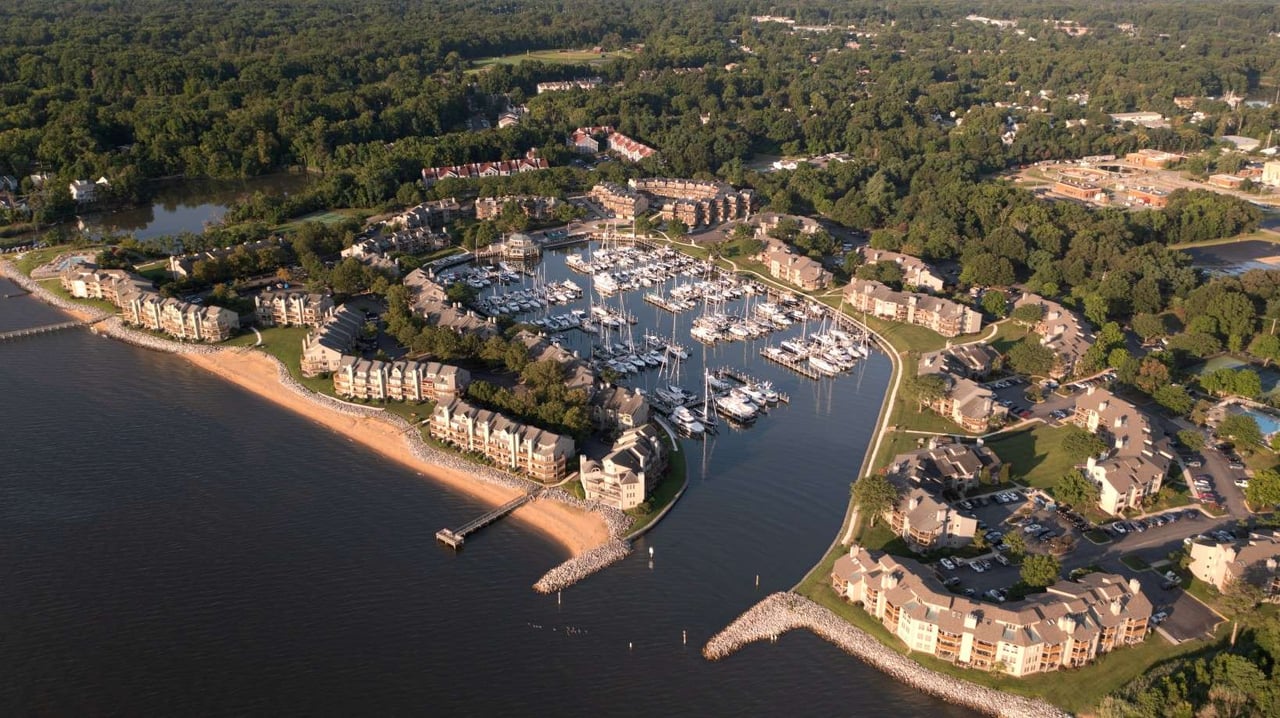
Picture the sailing day you want: a walk from home to the dock, a boat in place, and time to enjoy the water. What makes that routine possible? A berth you can obtain, an approach that suits your boat, and a clear understanding of who runs the docks.
Those questions belong beside the floor plan. Our view: choose the home and boating arrangement together. Saefern, Chesapeake Harbour, Fishing Creek Farm, Bay Ridge and Solomons Landing offer five ways to make that connection, with distinct housing, histories and routines.
This is a shortlist for comparison. Suitability depends on the boat and berth. The depth evidence ranges from association-published specifications to chart readings supplied for this guide that remain independently unconfirmed.
How to read the depth figures
A slip’s length, its water depth and an operator’s maximum accepted draft describe different things. A depth reported at a pumpout says little about the shallowest part of an approach. A range across a harbor does not identify the depth at the berth offered to you.
The reference level matters, too. NOAA distinguishes mean low water from mean lower low water: the former averages all low-water heights, while the latter averages each tidal day’s lower low water. Those definitions do not supply a missing datum for a local marina or establish clearance for a particular boat.
Five communities, five ways to keep a boat close
Saefern: wooded home sites and a shared club
Saefern’s community website describes 133 homes on wooded lots of roughly 1–1.5 acres between Clements and Saltworks creeks. Its shared facilities include docks, a pool, courts and stables.
The community’s history traces its development to Eliot Y. P. Powell’s 1960s plan for large private lots and shared amenities. Those facilities belong to the private, self-managed Saefern Saddle & Yacht Club, which homeowners are eligible to join through annual membership. Confirm the membership terms alongside the home.
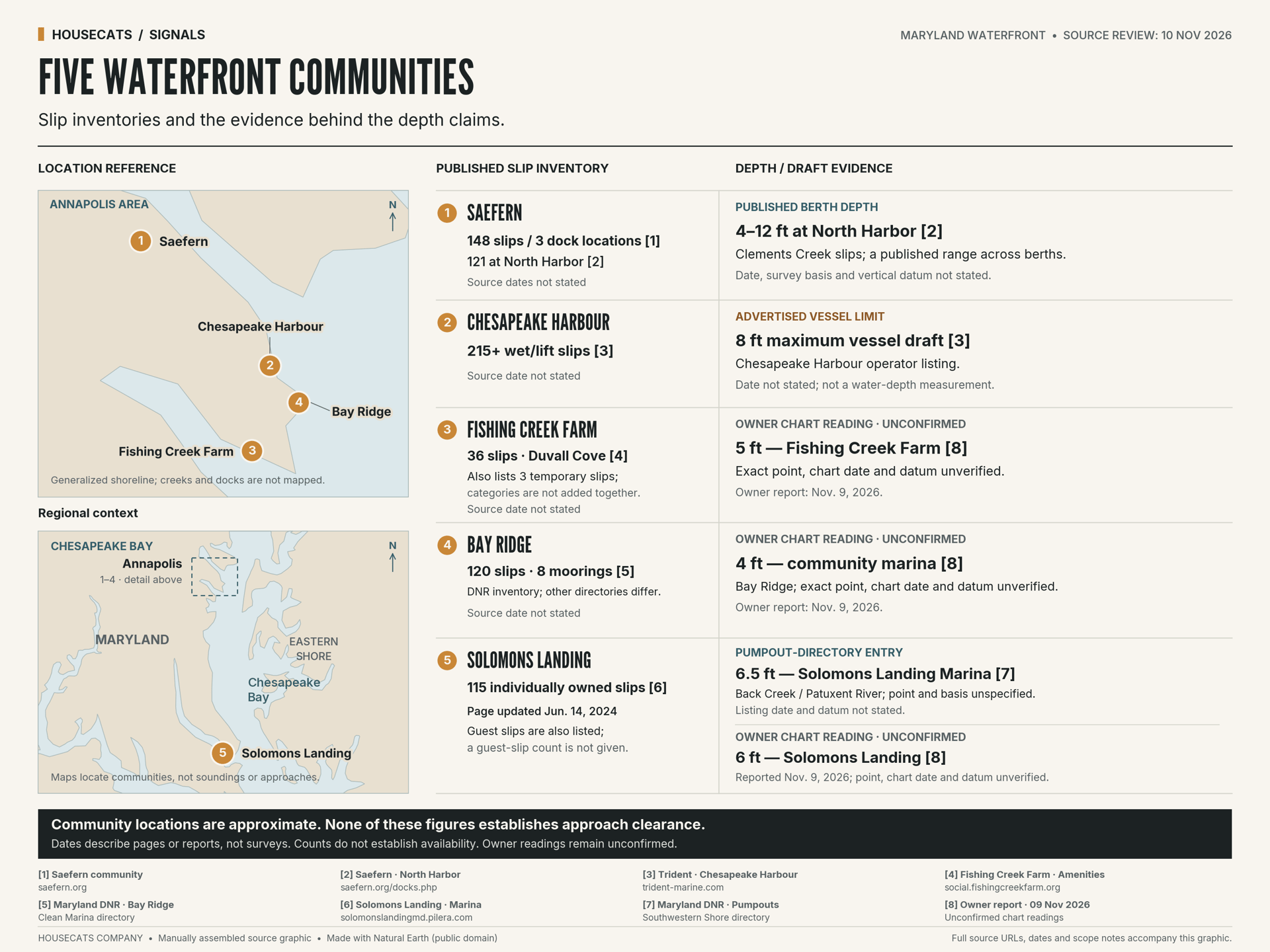
At North Harbor on Clements Creek, the association publishes 121 slips, 22–46 feet long, and a 4–12-foot depth range. It describes water, electricity, pumpout service and dockmaster assignments based on a boat’s size, width and draft. The depth range has no stated survey date or tidal datum; it is not a verified continuous approach minimum.
The community-wide figure of 148 slips covers multiple dock locations. It should not be read as 148 interchangeable deep-water berths. South Harbor serves smaller craft, particularly boats 15–20 feet long with minimal draft requirements, and includes storage and a ramp. Its page also describes volunteer dock-maintenance workdays.
The home-and-boat fit: Consider Saefern for wooded home sites and shared club participation. Ask which harbor and berth fit your boat and how assignment works today. Eligibility and past accommodation without a waiting list do not guarantee a suitable current slip.
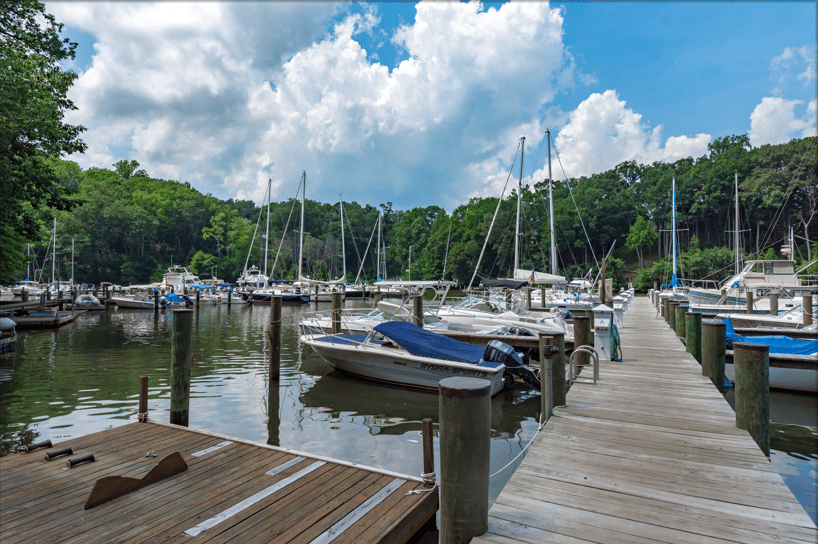
Chesapeake Harbour: condominium living beside a commercial marina
Chesapeake Harbour combines condominiums and townhouses with an on-site marina. Canton Kayak Club’s location information identifies the gated residential community and the publicly accessible Beacon Waterfront restaurant. Its resident-oriented kayak arrangement is separate from marina slip access.
Trident Marine Group advertises 215-plus wet/lift slips, annual or seasonal arrangements, transient reservations, and facilities including shore power, bathhouses, laundry, pools, courts and a restaurant. The operator lists a maximum vessel length of 120 feet and a maximum draft of 8 feet.
That eight-foot figure is an advertised vessel limit, not a survey showing eight feet of water everywhere. A boat drawing more than eight feet exceeds the published maximum. Even a boat within that specification needs confirmation for its exact berth, approach and operating conditions. Homeownership beside the marina does not establish an included slip, transfer rights or resident priority.
The shoreline also carries a history that belongs in any account of the community. A photographed historical marker states that Jerome J. Parks acquired Carr’s Beach and surrounding land in 1984 to build the Village of Chesapeake Harbour. The City of Annapolis describes Carr’s and neighboring beaches as Black-owned recreation and music destinations during segregation.
In 2022, the city acquired the 5.17-acre Elktonia-Carr’s Beach parcel for public preservation and park development. That public preservation project is separate from Chesapeake Harbour’s private residential amenities.
The home-and-boat fit: Consider condominium or townhouse living beside a serviced commercial marina. Investigate the specific home, the operator’s terms and an available berth separately.
Fishing Creek Farm: a peninsula with several kinds of water access
Fishing Creek Farm’s amenities page describes approximately 120 homes on a peninsula near Thomas Point, with more than 100 acres of protected open space, beaches, a waterside pool, clubhouse, tennis court and a crabbing pier on Fishing Creek. Boating sits alongside other reasons to spend time outdoors.
In the association-published community history by Margo Speciale, the land’s earlier hunting and recreational uses give way to custom-home development in the 1990s. This is the community’s attributed account; the underlying property records were not independently examined.
The private marina is on Duvall Cove. The association lists 36 slips, three reservable temporary slips and some transient slips, but does not clarify whether those latter categories are additional. It also describes a mooring field, pumpout, ramp, small-craft dockage, some lifts and outer slips suited to deeper-draft vessels. It publishes no numerical marina-wide depth.
The chart reading for Fishing Creek Farm supplied for this guide is 5 feet and remains independently unconfirmed. It does not establish an approach, fairway or all-berth minimum. Likewise, the association’s reference to deeper outer slips needs to be matched to a particular boat and a particular slip; it does not establish availability.
The home-and-boat fit: Consider the custom-home setting alongside the beach, pool and other outdoor routines. Keep the boat-to-berth question specific, especially if your search depends on one of the deeper outer locations rather than the marina in general.
Bay Ridge: a neighborhood shaped by the shore and civic life
Annapolis Home Magazine’s account of Bay Ridge traces a Victorian resort reached by rail and steamship into a residential community. It describes a housing mix that includes winterized 1920s cottages and later homes, and documents the Big Woods preservation effort. The result is a varied housing search.
The Bay Ridge Civic Association dates its mission to 1927 and describes neighborhood meetings at the marina clubhouse, forest protection and shoreline erosion work. That civic role does not establish a homeowner’s right to a wet slip.
Maryland DNR’s undated marina listing reports 120 slips, eight moorings, a pumpout and a resident boat ramp. Current availability, allocation, waitlist priority and transfer rights need separate confirmation. The association’s detailed marina-information page required a login during this research, so those terms remain unresolved here.
The chart reading for Bay Ridge’s community marina supplied for this guide is 4 feet and remains independently unconfirmed, including its datum and approach conditions. Separate information supplied for this guide mentions deeper water at some private piers, but gives no depth, particular pier or available berth. A private-pier property and the community marina require separate checks; neither establishes the other’s depth or access rights.
The home-and-boat fit: Bay Ridge warrants consideration if its mix of houses, shoreline setting and civic involvement matches the way you want to live. If keeping your sailboat nearby is essential, resolve the actual marina allocation or private-pier arrangement early enough to inform the property decision.
Solomons Landing: condominium homes and individually owned slips
Solomons Landing’s association describes 225 condominium homes in 15 buildings on a 34-acre peninsula overlooking Back Creek. Its published amenities include a one-mile shoreline trail, waterfront dock, pool, gym, courts, pavilion and small-craft storage.
A 2001 Washington Post report dates the development to 1988. The report supplies historical context rather than current marina operating information.
The association’s marina page, last updated June 14, 2024, lists 115 individually owned slips, 25–65 feet long, with water, electricity, pumpout facilities, guest slips and small-craft racks. The page calls them deepwater but supplies no numerical depth or accepted-draft specification.
The chart reading for Solomons Landing supplied for this guide is 6 feet and remains independently unconfirmed. Separately, Maryland DNR’s pumpout directory lists a 6.5-foot depth entry at the Solomons Landing pumpout location. That entry has no measurement date or stated tidal datum and does not establish an approach or all-berth minimum. It does not independently confirm the six-foot reading.
The home-and-boat fit: Consider the condominium and the slip as related but separate interests. Because slips are described as individually owned, a condominium purchase should not be assumed to include one. Identify the particular slip, how it can be obtained, and whether its dimensions and approach work for your boat before relying on the pairing.
Choose the routine as carefully as the address
The five communities offer distinct residential arrangements. Saefern combines wooded home sites with a shared club. Chesapeake Harbour places condominiums and townhouses beside a commercial marina. Fishing Creek Farm pairs a custom-home setting with a smaller, varied marina and shore-based amenities. Bay Ridge brings a mix of housing and a documented civic tradition. Solomons Landing combines condominium living with separately owned slips.
Our interpretation starts with the responsibilities you want: club membership and assignment, a commercial operator’s reservation terms, individual slip ownership, or a private pier. Consider the home, shared facilities and everyday routine around that arrangement.
A promising neighborhood becomes a useful candidate when the housing and boating details work together.
Before a house becomes your sailing base
Bring a short, concrete set of questions to each property and marina conversation:
- Start with the boat. Record its length, beam, draft and air draft. Use those specifications when discussing a berth rather than relying on a general deep-water description.
- Identify the berth. Ask for the actual slip or mooring, who controls it, and how it can be obtained. Confirm current availability, eligibility, assignment or lease terms, and any transfer or waitlist provisions.
- Trace the route. Request current information for the approach, fairway and berth. Ask where the limiting depth is reported, what units and reference level apply, and when and how it was measured.
- Clarify the ongoing arrangement. Ask about fees, utilities, maintenance responsibilities, seasonal operations and any planned work. These are questions to resolve for the specific arrangement, not services or obligations assumed by this guide.
This is a residential lifestyle guide, not a navigation plan. The practical goal is to put the property and berth information in front of the relevant community or marina operator while you can still use the answers to compare homes.
What to recheck before you act
A current depth report, a changed slip assignment or new marina terms could change the fit for your boat. Recheck dated information and ask whether maintenance or operating arrangements have changed since the source material was published. Past accommodation is not present availability.
At Elktonia-Carr’s Beach, the city describes proposed shoreline restoration and public recreational and educational access. Its page included a September 15, 2026 permit-comment deadline; the passage of that date does not establish permit approval or completed construction. Follow the public project for its preservation and public-access plans. It supplies no basis for an assumption about marina fairway depth.
Start with your boat and the life around it
A useful shortlist connects a home you want with a boating arrangement you can use. Consider the shared facilities, responsibilities and neighborhood setting that remain when the boat stays at the dock.
Bring Housecats your boat’s specifications and the daily routine you want. We can help you compare the neighborhood options and organize the property and berth questions that deserve answers before you decide.
Research note: Depth figures and access details that could not be independently confirmed are identified in the text. Water depth and slip availability vary by location and conditions. Confirm the specific berth, approach and current marina rules before relying on this guide for a property or boating decision.