
Annapolis makes a useful starting point for understanding Maryland’s college scene. The Naval Academy prepares future naval officers. St. John’s brings students into a shared curriculum built around books, questions, and discussion. Same city. Very different undergraduate lives.
That contrast runs through the state. Maryland offers research universities, art and music schools, historically Black institutions, small liberal arts colleges, professional campuses, and pathways designed around working adults. The name on the sweatshirt tells you something. It does not tell you what an ordinary week will feel like.
The better question is not simply, “Which Maryland college is best?” It is, “Which kind of college life are we looking for?” And for anyone considering a home or investment near a campus, there is a second question: what actually connects that institution to the surrounding housing market?
This is a selective field guide to Maryland colleges and the places around them—not an admissions ranking or an exhaustive directory. The emphasis is on academic identity, campus experience, and the distinctions worth understanding before planning a visit or a move.
Start With the Right Campus—not Just the Right Name
Several names need untangling before you draw a map. The University of Maryland, College Park is the flagship campus people generally mean by “UMD.” The University of Maryland, Baltimore is a separate institution centered on professional and graduate education. UMBC is another distinct university, with its own campus and academic community in Baltimore County.
University of Maryland Global Campus emphasizes online education and working adults. University of Maryland Eastern Shore is in Princess Anne. Those are not interchangeable locations—or interchangeable student experiences.
Two more easy mix-ups: St. Mary’s College of Maryland is the public honors college in St. Mary’s City, while Mount St. Mary’s University is the Catholic university in Emmitsburg. Washington College is in Chestertown, not Washington, D.C.
These distinctions sound basic until someone starts comparing apartments, planning a commute, or booking campus visits around the wrong address.
Annapolis: Two Very Different Ways to Spend Four Years
United States Naval Academy: College With a Service Mission
The Naval Academy’s academic program combines a broad core with specialized majors and professional preparation for service in the Navy or Marine Corps. Its defining distinction is not simply demanding coursework. Military development and leadership are part of the institution’s purpose.
That changes the housing picture, too. All midshipmen live in Bancroft Hall. A family evaluating the Academy should be considering the service-academy model, not imagining an ordinary off-campus undergraduate apartment search.
One familiar graduate is David Robinson, Class of 1987, whose career with the San Antonio Spurs followed his years at Navy. That is a recognizable connection; the more important decision for a prospective midshipman is whether the Academy’s mission fits their own.
St. John’s College: The Conversation Is the Curriculum
St. John’s Great Books program is built around a common course of study rather than a conventional menu of undergraduate majors. Reading and discussion sit alongside mathematics, laboratory work, language, and music. The question is not only what students read, but how they learn to examine and argue through it together.
For someone energized by sustained discussion across disciplines, that can be the attraction. Someone seeking a narrowly prescribed professional major should examine the curriculum just as carefully. Neither preference is a verdict on the college; they are different ways to learn.
For Annapolis residents, these institutions also offer a different lens on the city. Understanding the colleges means looking beyond the waterfront photograph to the educational lives taking place around it.

College Park and Bowie: Breadth, Identity, and Different Campus Rhythms
University of Maryland, College Park: The Broad University Experience
College Park is a natural place to start when a student wants academic breadth. UMD’s colleges and schools span engineering, computer and natural sciences, business, journalism, arts and humanities, education, public health, and other fields. The opportunity is to explore different interests within a large university; the practical task is to understand the particular program, advising, and community that would make it feel manageable.
It is worth resisting the idea that a university has only one personality. Jim Henson graduated from Maryland in 1960. His connection adds a creative thread to a campus that is easy to describe only through research or athletics.
On a visit, go beyond the main lawn. Find the building where the intended major lives, investigate housing, and test the journey between them. A university-wide impression is only the beginning.
Bowie State University: An HBCU With Several Academic Stories
Bowie State is Maryland’s oldest historically Black college or university, founded in 1865. Its current academic mix includes science, technology, business, education, nursing, and the arts. Its facilities include a natural sciences, mathematics, and nursing center and a fine and performing arts center with digital-media capabilities.
The university describes both a residential campus and evening and online study for employed professionals. That is an important combination to investigate: a prospective resident and a working student may be looking at the same institution but organizing very different weeks.
Bowie deserves its own visit and program research—not treatment as a footnote to College Park.
Baltimore Is Several College Environments, Not One
Johns Hopkins: Ask Which Part of Hopkins
Hopkins’ name can obscure its geography. Its Baltimore campuses include Homewood, associated with undergraduate arts and sciences and engineering; East Baltimore, with medicine, nursing, and public health; Peabody in Mount Vernon; and the Carey Business School’s Harbor East location.
A student headed to conservatory rehearsals, one working in a Homewood laboratory, and one training in a health profession do not have the same destination. That matters when comparing daily routines, transport, and housing. “Close to Hopkins” needs a follow-up question.
The university’s history also reaches beyond medicine. Writer and biologist Rachel Carson earned her master’s degree at Hopkins in 1932. It is a reminder to investigate the actual discipline rather than reduce the institution to its most familiar association.
University of Maryland, Baltimore: A Professional-School Setting
UMB’s schools cover dentistry, law, medicine, nursing, pharmacy, social work, and graduate study. The institution has a different focus from College Park’s broad undergraduate campus.
For someone comparing places to live, the useful questions are correspondingly specific. Where are the classes, clinical placements, or other required activities? Which parts of the week require travel? A general “college-town” description tells you less than the schedule of the actual program.
UMBC: A Separate Research Community
UMBC combines research with undergraduate and graduate study across the sciences, engineering and computing, humanities, arts, and social sciences. Its Baltimore County campus is not the downtown UMB campus, despite the similar names.
Kizzmekia Corbett, a 2008 graduate in biological sciences and sociology, went on to play a central scientific role in the development of the NIH–Moderna COVID-19 vaccine. Her academic combination is more revealing than a generic “STEM school” label: look at how a university supports the interests a student wants to bring together.

Morgan State and Coppin State: Look at the Programs Behind the Names
Morgan State’s academic range includes engineering, architecture, business, education, social work, hospitality, and the arts and sciences. Its historically Black institutional identity and broad program mix belong together in the story. Black Enterprise founder Earl G. Graves Sr. was a Morgan graduate, an alumni connection that helps explain the name of its business school.
Coppin State’s offerings include nursing, education, social work, management, computer science, and other professional and liberal arts pathways. Its program inventory also distinguishes undergraduate, graduate, certificate, and online options. Rather than treating these Baltimore institutions as interchangeable, compare the specific degree, placement requirements, support, and campus schedule.
MICA: A College Experience Built Around Making
The Maryland Institute College of Art brings a different academic model into Baltimore: art and design education, portfolios, studios, and exhibitions. For an aspiring artist or designer, the facilities and creative work deserve at least as much attention as the campus tour.
MICA’s alumni include painter Amy Sherald, who earned her MFA in 2004, and artist and performer Abbi Jacobson, who earned her BFA in 2006. Its public exhibitions and events also give nonstudents a reason to engage with the college. You do not need to be choosing a degree to make a campus part of your cultural life.
Loyola, Notre Dame, and the University of Baltimore: Different Models Within the City
Loyola University Maryland pairs a Jesuit, Catholic educational identity with its residential Evergreen campus and graduate study. Someone comparing it with a large public university should examine both the program and the educational approach, not just the number of majors.
Notre Dame of Maryland University offers liberal arts and professional fields including education, nursing, and art therapy. Older descriptions require care: its traditional undergraduate program became coeducational in fall 2023. A remembered institutional identity is not always a current admissions description.
The University of Baltimore adds another mix, with business, law, public affairs, and arts and sciences. For a reader returning to education or planning professional study, it belongs in the search. Confirm the level, location, and delivery format of the desired program rather than assuming every college experience begins in a first-year residence hall.
Towson and Beyond: Change the Setting, Then Compare the Model
Towson University offers a broad public-university mix: business, education, health professions, fine arts and communication, liberal arts, and science and mathematics. It is a useful comparison for students who want multiple academic directions within one institution. The next layer is practical: the particular college, placements or internships, housing arrangements, and how the campus connects with daily life in Towson.
Goucher College, also in Towson, offers a smaller liberal arts model. Its study-abroad curriculum makes international learning a central consideration. Investigate how that requirement, including applicable exceptions or alternatives, fits a student’s degree plan and circumstances.
Stevenson University explicitly connects academic study with career exploration, professional preparation, and employer engagement. That makes the quality of the intended program’s applied experience an especially useful question for a visit. Ask what students actually do, when they do it, and what support helps them connect it to work.
Farther out, McDaniel College in Westminster provides another small-college option. Its McDaniel Plan combines general education, major requirements, and electives. It belongs in a comparison focused on how much structure and flexibility a student wants—not merely whether the campus has a familiar name.
The Eastern Shore and Southern Maryland: The Setting Becomes Part of the Education
Washington College: Chestertown, Writing, and the Chesapeake
Washington College is a liberal arts institution in Chestertown with several distinctive ways into the region. The Rose O’Neill Literary House anchors a literary thread; the Center for Environment & Society and Chesapeake Semester connect academic work with the surrounding landscape and waterways.
That is more specific than saying a campus is “beautiful.” For a student interested in writing, environmental questions, or place-based learning, examine how those opportunities enter the undergraduate experience. For someone considering Chestertown as a place to live, the college’s event calendar offers a starting point for exploring lectures and cultural programming, with access checked event by event.
Salisbury University: A Broader Regional-University Mix
Salisbury University’s schools and colleges span business, education, health and human services, liberal arts, and science and technology. It offers a different comparison from a small, primarily liberal arts college: several professional and academic directions within a regional public university.
The location needs its own attention. Research Salisbury as Salisbury, not as an interchangeable version of Chestertown or Annapolis. When visiting, test the campus routine and the surrounding place you would actually use.
University of Maryland Eastern Shore: Applied Fields in Princess Anne
UMES is a historically Black, land-grant university in Princess Anne. Its programs include agriculture, aviation science, pharmacy, and marine and environmental study, alongside other disciplines.
For a student drawn to one of those applied fields, the program itself should lead the visit. Ask about facilities, field or professional experience, and the route through the degree. The attraction may be a particular educational opportunity rather than a generalized idea of college-town life.
St. Mary’s College of Maryland: A Public Honors College on the River
St. Mary’s College of Maryland combines public honors education with a liberal arts setting on the St. Mary’s River. Marine science, environmental study, and the waterfront offer obvious points of connection, but the institution is not limited to water-related disciplines.
Its residential promise matters, too: the college advertises guaranteed on-campus housing for four years. For students, that is part of planning the experience. For a property investor nearby, it is a reason to investigate off-campus demand rather than assume that every student will need a private rental.

Do Not Leave the Other Pathways Off the Map
A Chesapeake-focused search is not the whole Maryland picture. Hood College in Frederick combines liberal arts and professional study. Mount St. Mary’s in Emmitsburg offers a Catholic university setting. Frostburg State University adds a western Maryland public-university option. A student interested in a different geography should compare those places directly rather than stretch a Baltimore or Annapolis search to stand in for them.
Community colleges also belong in the main conversation, not in a footnote. Anne Arundel Community College, Howard Community College, the Community College of Baltimore County, Chesapeake College, and the College of Southern Maryland are among the state’s institutions to investigate for local study and transfer planning.
Maryland’s ARTSYS transfer system provides course-equivalency and transfer-program information. Use it with an adviser and the receiving institution’s requirements. A course transferring is not the same question as that course satisfying the requirement you need for a particular major.
Finally, UMGC’s online programs and working-adult focus widen the definition of college life again. Business, cybersecurity, computing, and other fields can be pursued through an educational model that does not revolve around moving into a campus neighborhood. For someone balancing work, military service, or other responsibilities, delivery format may be as important as geography.
Compare an Ordinary Week, Not Just an Open House
A campus visit should help answer something more useful than whether everyone enjoyed the tour. Start with the intended program. Ask where it is taught, what the early courses look like, how students get advice, and which opportunities require a separate application or additional cost.
Then work through the week: the trip to class, the space to study, the evening routine, the food options, and the journey home. Visit while classes are in session when possible. A pleasant afternoon can help you notice a place; it cannot answer all the questions about living there.
Compare the household budget in the same concrete way. Ask each institution for the costs that apply to the student’s situation, including housing, meals, transport, and any program-specific expenses. Evaluate aid and its renewal conditions before assuming two published tuition figures describe two equivalent financial commitments.
For nearby homeowners, the question changes again. You may care about attending exhibitions, hearing a guest speaker, or living near an active campus without wanting your daily route to depend on it. Look at actual calendars and access arrangements, and spend time in the surrounding streets. The useful lifestyle benefit is the part you would genuinely use.
The Real-Estate Connection: A College Is Not a Rental Guarantee
There is a credible housing conversation here, but it starts with distinctions—not a list of famous schools beside a list of expected returns.
Count the People Who Need That Housing, Not Everyone on the Enrollment Roll
The Academy is the clearest example. Its Bancroft Hall residential model means you should not treat the midshipman population as an ordinary pool of off-campus undergraduate tenants. A property near USNA would need a different, independently supported rental case.
Hopkins presents another distinction. Its Homewood undergraduate housing policy generally requires two years in university housing, with an approved parent-or-guardian commuting exception. That is not the same policy as “all Hopkins students rent nearby.” Graduate students, professional students, and employees require separate research—and the relevant campus still matters.
Likewise, a university with substantial online education does not create a local housing need for every enrolled student. Enrollment is a starting question, not a rent roll.
Campus Growth Can Also Mean More Housing Supply
In May 2026, Hopkins announced the start of construction at the AMR I site, with a replacement residence hall intended to accommodate twice as many first-year students as the previous building. The announcement anticipated completion by the end of 2028. It describes a project in development, not housing already delivered.
The implication is worth watching, not overstating: an institution can invest in its campus while also changing where its students live. Before treating expansion as automatically favorable to nearby landlords, examine which students would occupy the new beds, which beds they replace, and when they are actually available.
Permission to Rent and Evidence of Rent Are Different Checks
A property can be close to campus and still fail the intended rental plan. The City of College Park’s rental guidance, for example, addresses residential occupancy permits and annual inspections. That is a reason to confirm the rules for the exact address—not to assume that a house’s advertised bedroom count establishes lawful occupancy or rental use.
We would organize a property review around five questions:
- Who is the likely occupant? Identify a supported demand group and the campus or workplace it needs to reach.
- What use is allowed? Confirm the relevant rental, occupancy, association, and short-term-stay requirements before relying on a plan.
- What do comparable leases support? Separate signed rents and occupancy evidence from advertised prices.
- What does ownership cost? Include financing, taxes, insurance, management, maintenance, turnover, and vacancy in the review.
- What is the alternative? Test whether the property still works if the original tenant assumption does not.
Keep event accommodation separate from a year-round tenancy model. A high advertised rate for one graduation weekend does not establish annual occupancy, a legal short-term rental use, or a profitable investment.
The university is part of the location. The property still has to make sense on its own.
What to Watch as the College Map Changes
For a family comparing colleges, watch changes in program location, delivery format, and housing policies. The most useful update may not be a ranking; it may be that the program now meets somewhere else or that the housing arrangement is different from what you expected.
For an owner or investor, track residence halls and competing housing that actually open, not just projects announced. Review the intended occupants, replacement beds, and changes in transport access. Those details can change a property’s usefulness without changing the name of the university nearby.
Maryland’s college scene is appealing precisely because it is not one scene. A seminar in Annapolis, a studio in Baltimore, a broad university program in College Park, and fieldwork connected to the Chesapeake represent different ways to learn and live. The work is finding the connection that matters to you.
When that college search is also part of a move, continue with the Housecats Homebuyer Roadmap to connect the location question with your budget, search, and buying plan.
Programs, housing policies, and development schedules can change. Confirm decisions with the institution and the authorities or professionals responsible for the property. This is a regional lifestyle guide, not individualized admissions, legal, tax, or investment advice.
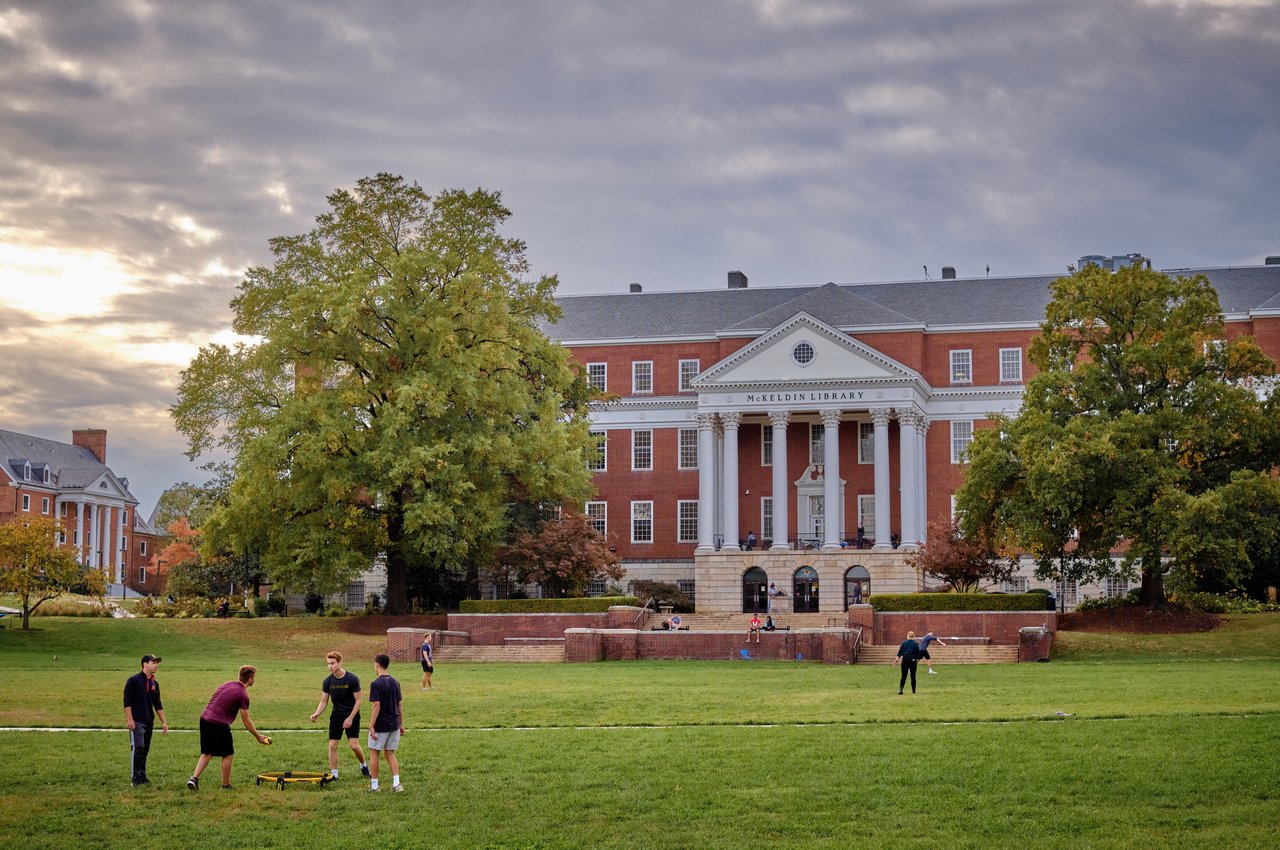
Header photograph: McKeldin Library and Mall, University of Maryland, College Park, 2019. Blacktupelo / Wikimedia Commons, CC BY-SA 4.0. Archival photographs illustrate place; they do not depict current campus construction. No institutional endorsement is implied.