
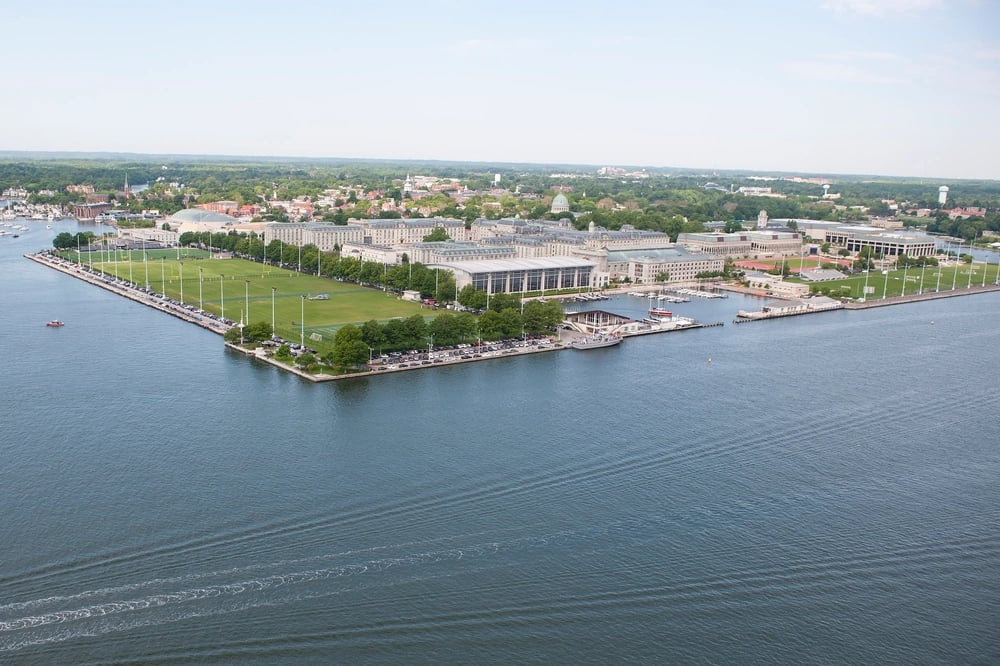
In Annapolis, a graduation is not confined to a campus. It can change traffic over the Severn, parking downtown, and how boats move through the river. The city's 2026 Commissioning Week plan makes that relationship unusually visible.
But the flyovers and white uniforms tell only part of the story. The United States Naval Academy is a place where people study, work, build friendships, and prepare for careers that will take them away from Annapolis. Understanding the city means understanding those ordinary routines, too.
The Academy gives Annapolis more than a landmark. It connects a local way of life to a national institution. That connection helps explain the city's character. Its effect on a particular home, rental, or daily commute takes a more specific conversation.
It Started With a School, Not the Skyline We Know
The Academy began as the Naval School on October 10, 1845, at Fort Severn, an Army post on the Annapolis waterfront. Secretary of the Navy George Bancroft established it as a place for formal officer education, adding a school-based foundation to learning at sea. The Academy's Business Services Division recounts that founding and the change to the U.S. Naval Academy name in 1850.
The relationship with Annapolis was interrupted during the Civil War, when the school moved temporarily to Newport, Rhode Island. It returned after the war. The institution's long association with the city is real; the idea that it has always operated here without interruption is not.
The familiar architecture came later. The Historic American Buildings Survey's study of Ernest Flagg's plan records a plan submitted in 1896 and a rebuilding commission in 1899. Its account emphasizes classical buildings, formal axes, and the arrangement of the campus as a whole.
That distinction changes how you look at the Yard—the Academy's campus. The monumental setting is not simply a collection of buildings left over from 1845. Much of its recognizable identity comes from a later, coordinated architectural vision. The founding and the physical place have related—but different—histories.

The Traditions Include a History of Change
It is easy to tell the Academy's history through buildings and ceremonies. The history of who could participate deserves equal attention.
Wesley Brown became its first Black graduate in 1949, after entering in 1945. His U.S. Naval Institute oral history records the challenges he faced and the personal relationships that helped sustain him. The milestone matters, but so does the experience behind it.
Women first entered in 1976; the first 55 women graduated in 1980. The Naval Institute's oral histories document that first class's experiences rather than presenting the transition as effortless. In 2026, fifty years after women's entry, those accounts offer a useful reminder: the institution has changed even while preserving many of its rituals.
A more complete understanding of Annapolis holds both ideas at once. Tradition explains part of the Academy's identity. The people who challenged its boundaries explain another.
Why This Small-City Campus Matters Nationally
The Academy's students are called midshipmen, and its purpose is officer development—not simply awarding a college degree. Its official mission brings moral, mental, and physical development together with preparation for naval service. It is one route into the officer corps, not the only one.
The Academy's description of its program connects academic study, professional training, and commissioning into the Navy and Marine Corps. That is why a local graduation also has a national meaning: it marks the transition from education into service.
Familiar graduates make the reach easier to picture. Alan Shepard graduated in 1944 and became the first American in space in 1961. David Robinson, Class of 1987, later won NBA championships with the San Antonio Spurs. Those biographies connect Annapolis to audiences far beyond military circles, without suggesting that celebrity is the measure of the school's mission.
The Chesapeake Is Still Part of the Classroom
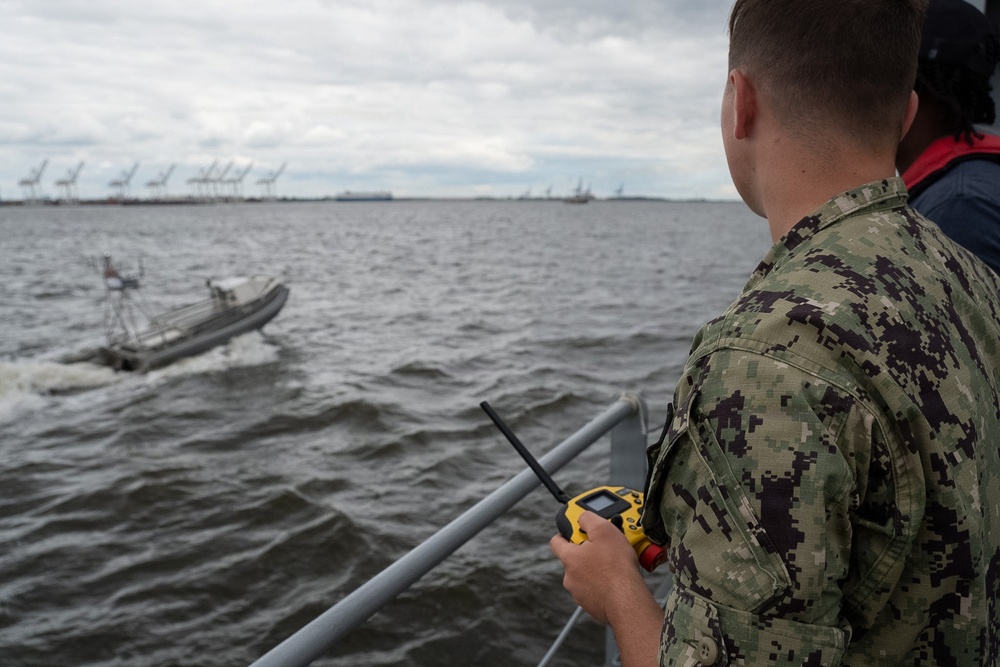
The contemporary work is worth noticing, too. In August 2026, the Academy reported its first YP NEXT summer training block, combining robotics and autonomous systems with seamanship and navigation aboard Yard Patrol craft. The program included work with the Johns Hopkins University Applied Physics Laboratory and a visit to maritime-technology manufacturing in Baltimore.
It is a concrete regional connection: the Academy's education reaches into research, industry, and the water itself. The historic waterfront setting is also a working training environment.
Some of the Strongest Connections Happen Away From the Yard
The Academy is intensely residential. Bancroft Hall houses the Brigade throughout its four years. That matters to student life, and it matters to anyone trying to understand the institution's relationship with nearby housing.
Living inside the gates does not mean having no life beyond them. The midshipman sponsor program connects Annapolis-area households with students for encouragement and time away from the Academy. A meal, somewhere to study, a load of laundry, or a conversation can be the point. These are support relationships—not an off-campus leasing program.
The program's account describes friendships continuing after graduation. That offers a more personal explanation of the city's connection to the Academy than a visitor count could. Annapolis can become a place associated with people who helped, not just the place where someone attended school.
A Rivalry That Could Only Belong Here
Then there is croquet. Since 1983, St. John's College and the Naval Academy have competed for the Annapolis Cup. A Great Books college and a service academy make unlikely sporting neighbors, which is part of the attraction.
The match is a useful picture of local identity: two institutions with very different educational lives creating a shared tradition. Annapolis is not interesting because everything here has the same character. It is interesting because these differences sit so close together.
The Academy Has a Calendar. The City Lives With It.
The Alumni Association's parent and alumni resources connect families, parent clubs, and returning graduates with the institution. These relationships extend beyond a student's first arrival and help explain why the Academy has both a daily presence and recurring occasions that bring people back.
Commissioning Week shows the distinction clearly. For May 2026, the city's plan addressed Blue Angels-related closures of the Route 450 Naval Academy Bridge, downtown parking pressure, restrictions on maritime traffic, and changes to Eastport traffic patterns. Graduation took place at Navy-Marine Corps Memorial Stadium on Rowe Boulevard.
Those are examples from a specific year, not next year's travel instructions. Their significance is the geography: an Academy event can affect downtown, the river, the stadium area, and streets beyond the Yard itself.
For a prospective resident, there is a simple test. Visit on an ordinary day, then understand the event-day version of the same location. Being near the activity may be part of the appeal. So may having a daily route that does not depend on moving through it. Neither preference is wrong; it belongs in the housing decision.
You Do Not Need a Military Connection to Learn From the Place
The Naval Academy Museum interprets naval history, sea power, and officer education through its collections and exhibits. Official tours add context to the architecture and the working campus. The Academy's visitor and events resources offer ways to investigate what is open and happening.
Plan the visit around the questions that interest you. For architecture, look at the relationship between buildings rather than checking off facades. For history, allow time for the museum. For someone considering Annapolis as home, notice how the walk to the Yard connects with the rest of the day.
Check access before making plans. The official trip-planning page directs visitors to current base-access guidance. This is a working military installation, not a public park with permanently fixed entry arrangements. Identification, security, hours, and event access need current confirmation.
How the Naval Academy Connects to Annapolis Real Estate
The Academy's influence is easier to understand when we separate three questions: who needs a home, who needs a place to stay, and who wants to live near an institution that matters to them. Those questions can overlap, but they do not produce the same property requirements.
Year-Round Housing: Look Beyond the Midshipman Count
The residential Brigade should not be counted as a conventional pool of off-campus undergraduate tenants. Its home is Bancroft Hall. A rental plan described as “close to the Academy” needs a more specific occupant than an assumed midshipman tenant.
There is a separate housing conversation for personnel arriving to work in the area. Military OneSource's Annapolis housing resource describes government and non-government housing, a Housing Welcome Center, and off-base rental assistance. That is evidence of an actual housing pathway—not evidence that every nearby property will attract a military tenant.
For relocating households, the details are personal: the length of the assignment, other household commutes, the move date, and the costs of renting versus owning. Confirm those before deciding whether to rent or buy, and where to search.
Visitor Stays: A Different Calendar and a Different Business
Commissioning, family visits, and alumni events create reasons to come to Annapolis. They do not establish the annual income of a particular short-term rental.
A published graduation-week asking rate is not the same as a completed booking. A completed booking is not the same as year-round occupancy. And gross booking revenue is not what an owner keeps after expenses.
For a proposed rental, we would ask for documented rental rates and occupancy, lawful use, operating costs, and an alternative plan if the expected bookings do not materialize. A property should not require every assumption about its best week to come true.
Lifestyle Value: Important, but Not an Appraisal Adjustment
A connection to the Academy may matter personally—to an alumnus, a sponsor household, a family, or someone who enjoys the institution's public life. That can be a genuine reason to prefer Annapolis.
Personal significance and a measurable price premium are different things. The research for this article does not isolate how much of an Annapolis home's price is attributable to the Academy. We would not assign a percentage simply because the institution is prominent. Comparable sales, the property's condition, its setting, and usable access still need their own analysis.
“Close to the Academy” Needs an Actual Destination
The Yard, the stadium, and the facilities across the Severn are not the same place. Military OneSource locates Naval Support Activity Annapolis across the river and describes its support role for Academy training and operations.
For a home search, begin with the entrance or workplace you will actually use. Then test the trip, the parking arrangement, and the return journey. A short distance on a map does not answer the whole access question.
For sellers, this is also better marketing. Describe the property's relevant routes and features accurately rather than rely on “minutes to Navy” as a substitute for detail. A buyer deciding how to live there needs usable information.
Before Renting, Establish Which Rules Apply
The City of Annapolis rental portal distinguishes a short-term rental license from its Navy/Boat Show-only registration process. Even an event-only plan is not simply a no-paperwork arrangement.
Anne Arundel County publishes a separate short-term residential rental process. Establish the property's jurisdiction, then ask the responsible authority about current eligibility, restrictions, registration or licensing, and taxes. Confirm any association, insurance, and financing conditions as well.
The existence of an application portal is not a determination that an individual address qualifies. Nor should a provision for a particular event be assumed to authorize unrestricted year-round use.
What to Watch: The Connections, Not Just the Institution
Gate access and downtown connections. In its August 25, 2026 City Dock update, Annapolis said the Academy was expected to reopen Barry Gate in December 2026, restoring a pedestrian connection to the Dock Street business corridor. That was an expected milestone, not a completed reopening. Watch what actually opens and how people can use it.
The relevant calendar. Use current Academy and city notices when arranging visits, showings, or moves. A familiar annual event can still have different access and traffic arrangements from one year to the next.
Evidence behind a property plan. For an owner or investor, watch actual leases, bookings, expenses, and permitted uses. Institutional visibility is not a substitute for those records.
The Naval Academy makes Annapolis a place where a local afternoon and a national story can overlap. Its history, service mission, community relationships, and physical presence all contribute something different.
The best way to understand living here is to see both versions: the Annapolis people travel to for a milestone, and the Annapolis someone comes home to on an ordinary evening.
When that interest becomes a home search, use the Housecats Homebuyer Roadmap to connect the place you want to live with your budget, search, and buying plan.
Research reviewed September 2026. Confirm current visitor access, event arrangements, project schedules, and property requirements before acting. This article is regional history and general information, not individualized legal, tax, lending, or investment advice.
Header image: Naval Academy aerial described as taken in 2016; the DVIDS record was posted in 2021. Credit: Regina Adams / Naval Facilities Engineering Systems Command Washington, via DVIDS. Archival photographs do not depict current construction or access conditions.
The appearance of U.S. Department of War (DoW) visual information does not imply or constitute DoW endorsement. DVIDS use conditions. No endorsement of Housecats by the Naval Academy, U.S. Navy, or any pictured institution or individual is implied.